How to Respond to Negative Dental Reviews Professionally
One negative review—especially if it goes unanswered—can cost you real patient acquisition. A prospective patient sees that 1-star complaint, reads your silence or a defensive response, and calls your competitor instead.
The difference between losing that patient forever and turning a critic into an advocate often comes down to one thing: how you respond.
A thoughtful, specific reply to a negative review doesn’t erase the complaint. But it shows every other potential patient reading that review that you take feedback seriously, you act fast, and you care enough to make things right. That’s powerful.
Here’s exactly how to do it.
Why Your Response to Negative Dental Reviews Matters More Than the Review Itself
How patient reviews affect new patient acquisition
New patients reading your Google profile see your star rating first. But they read the reviews themselves before deciding whether to call.
When they land on a 1- or 2-star review and see a thoughtful response from the practice owner, they think: “This practice had a problem, but they handled it professionally.”
When they see no response, or a defensive one? They think: “This practice doesn’t care about patient experience.”
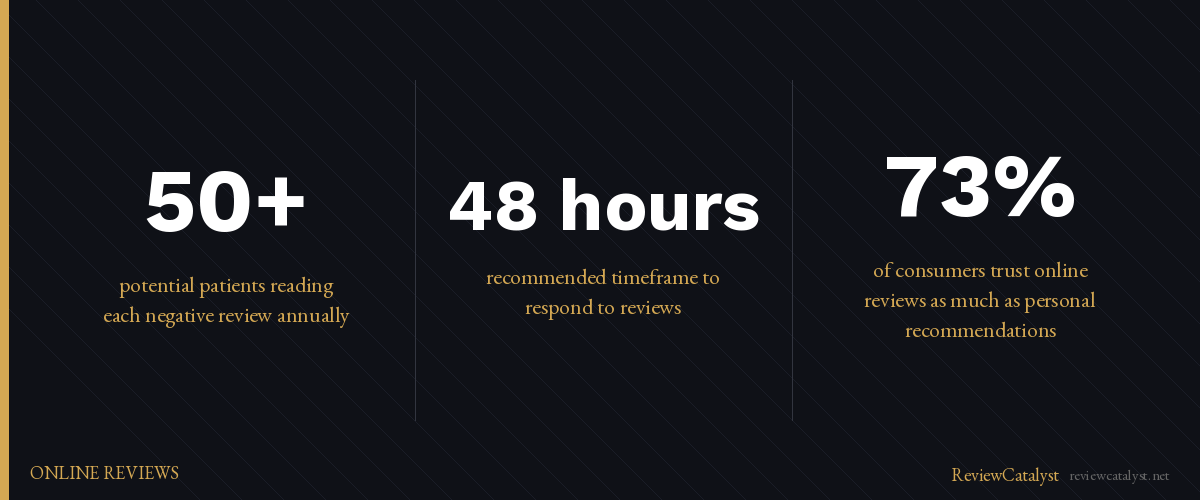
Your response is your chance to reshape how that review is perceived by the 50+ people who will read it in the next year.
What happens when you ignore or respond poorly
Ignoring a negative review signals to other potential patients that you don’t monitor feedback or aren’t concerned with patient satisfaction. That’s reputation damage compounded.
Responding defensively—arguing with the patient, getting clinical, explaining why they’re wrong—makes the situation worse. Other patients read that exchange and wonder if the practice prioritizes defending itself over listening.
The cost is real. Lost trust. Lost patients. A lower overall rating as negative reviews stack up unanswered.
The 5-Step Formula for Responding to Any Negative Dental Review
Step 1 — Never respond when you’re frustrated
Read the review. Feel the frustration. Then step away for at least 2 hours.
A response written in the moment often includes defensive language, poor tone, or details that only make things worse. Wait until you’re calm and can think clearly about what the patient actually said versus what you want to defend.
Step 2 — Acknowledge the patient’s experience specifically
Start your response by showing you actually read their complaint and understand what went wrong—or what they perceived went wrong.
Good: “I’m sorry your appointment was stressful. I can see from your review that the wait time was longer than expected and that frustrated you.”
Bad: “We’re sorry you had a bad experience.”
Specific acknowledgment proves you’re not using a template. The patient feels heard. Everyone else reading that exchange sees a practice that pays attention.
Step 3 — Apologize where appropriate (without admitting liability)
If the patient had a genuinely negative experience—long wait, poor communication, pain they didn’t expect—apologize directly.
You can apologize for their experience without admitting clinical error. “I’m sorry you experienced pain during that procedure” is different from “We made a mistake.” The first shows empathy. The second opens you to liability.
If the patient’s complaint seems unfounded or one-sided, skip this step. Move to the next one instead.
Step 4 — Offer a concrete next step
Never end a response with “We hope to serve you again.” That’s hollow.
Instead, offer something real:
- “I’d like to discuss this further. Please call me directly at [number] or email [address], and let’s talk about what happened.”
- “We’d like to make this right. Please reach out to schedule a follow-up consultation at no charge.”
- “Thank you for the feedback. We’ve made changes to our intake process based on input like this.”
A concrete next step proves you’re willing to actually fix the problem—not just manage the damage.
Step 5 — Keep your response short and professional
Responses longer than 2–3 sentences start to feel defensive. Keep it brief, kind, and solution-focused.
Sign it with your name and title. Make it personal, not corporate.
Common Mistakes Dentists Make When Responding to Bad Reviews
Defensive language and arguing with the patient. “That’s inaccurate” or “The patient is mistaken” only makes you look bad. Other readers side with the patient, not the practice defending itself.
Generic apologies that sound like templates. “We’re sorry you had a negative experience and value your feedback.” Everyone says that. Be specific about what went wrong and why it matters.
Ignoring the review or responding weeks later. A response 2 weeks after the review suggests you’re not actively managing your reputation. Respond within 48 hours whenever possible.
Trying to solve the problem entirely in public. If the issue is complex or sensitive, use your response to invite the patient to discuss privately. Don’t litigate patient care decisions on Google.
How to Turn a Negative Review Into a Reputation Asset
This sounds counterintuitive—but a practice with a few thoughtfully-answered negative reviews often gains more trust with new patients than a practice with only 5-star reviews.
Why? Because no practice is perfect. One bad review answered well proves you’re not hiding problems. Multiple complaints with no response? That’s a red flag.
Why a thoughtful response attracts more patients than a perfect rating would
A new patient reading a negative review and a professional response thinks: “This practice had an issue, acknowledged it, and tried to fix it. That’s what I want from my dentist.”
That response is worth more than another generic 5-star testimonial.
Patterns to watch for (recurring complaints signal real problems)
If you notice three patients complaining about wait times, or two mentioning billing confusion, that’s not coincidence—it’s diagnostic feedback.
Use negative reviews as a signal. If the same problem appears multiple times, it’s worth investigating and fixing in your actual operations, not just in your responses.
When and how to follow up privately
After you respond publicly, consider reaching out privately. A follow-up email saying “I want to make sure we resolved this to your satisfaction” can turn a detractor into a loyal patient. At minimum, they’ll understand you tried.
The Tool That Makes Responding to Every Review Effortless
Here’s what actually happens: you respond to one review thoughtfully, it takes 10 minutes. You respond to five, it’s an hour. By the time you have 20 unanswered reviews across Google and Facebook, responding feels impossible alongside patient care. So the reviews sit—and your rating suffers.
ReviewCatalyst fixes this. When a review lands, you see a draft response already written based on what the patient said—not a generic template. You personalize it in 30 seconds, publish, and move on. The platform also flags patterns in your reviews (recurring wait-time complaints, billing confusion) so you catch operational problems early instead of in crisis mode.
And if you’re managing multiple review platforms—Google, Facebook, and industry-specific sites—ReviewCatalyst keeps everything in one dashboard. You don’t hunt across tabs to find what needs a response.
Getting Ahead of Negative Reviews in the First Place
The best response is the review that never gets written in the first place—because you caught the problem early.
Collect feedback before patients leave public reviews. When you send a review request via SMS immediately after an appointment, you’re asking for feedback while the experience is fresh. Patients respond to a text message at a much higher rate than email.
More importantly: if a patient had a rough appointment, they’ll tell you privately before they post a 1-star review on Google. That gives you a chance to make it right.
When a patient responds to your review request, they land on a feedback page where they can choose to leave a public review on Google or another platform, send private feedback directly to your practice, or write a testimonial. That private feedback option is your safety valve—patients can share concerns before they go public, and you can address them one-on-one.
Identify and resolve issues early. The practice that reviews proactively instead of reactively catches problems like inadequate pain management, communication gaps, or scheduling friction. You fix the issue, the patient has a better second experience, and they never post that 1-star review.
This is why practices using review systems (instead of just hoping patients ask verbally) see their ratings improve over time. You’re not managing reputation crisis-to-crisis. You’re preventing crises.
Looking for the complete overview of dental reputation management? Read our full guide: Dental Reputation Management: How to Get More Reviews, Respond Faster, and Win More Patients
Your online reputation is your first impression with new patients. ReviewCatalyst’s free reputation audit shows you exactly what patients are saying, which reviews need responses, and where you’re winning—so you can protect and grow your rating strategically. Get your free audit at reviewcatalyst.net/reputation-audit.
Ready to get more reviews on autopilot?
ReviewCatalyst sends review requests via SMS automatically — no manual follow-up, no chasing customers.
Start Free Trial