What Makes Customers Actually Leave a Google Review?
A business with a 4.8-star rating and 200 reviews will get far more clicks on Google Maps than an identical business with the same rating but only 20 reviews. Same quality. Same rating. Different outcome.
The difference isn’t service. It’s volume.
Yet most local businesses leave reviews to chance. They ask a few customers verbally, get frustrated when nothing happens, and move on. They’re not wrong to ask — they’re just missing the system.
But here’s what really stops customers from leaving reviews: it’s not that they don’t want to. It’s that the friction is too high.
The #1 Reason Customers Don’t Leave Reviews (And It’s Not What You Think)
You’ve experienced this yourself. A business gave you great service. You meant to leave a review. You still mean to. But it never happens because reviewing requires you to:
- Remember the business name
- Find them on Google or Facebook
- Navigate to their review page
- Write something coherent
- Submit it
That’s five steps. Most people fail at step two.
Friction kills reviews more than lack of willingness. A customer who loves you but has to jump through five hoops will often do nothing. A customer who’s mildly satisfied but gets asked right now, with one click, will review.
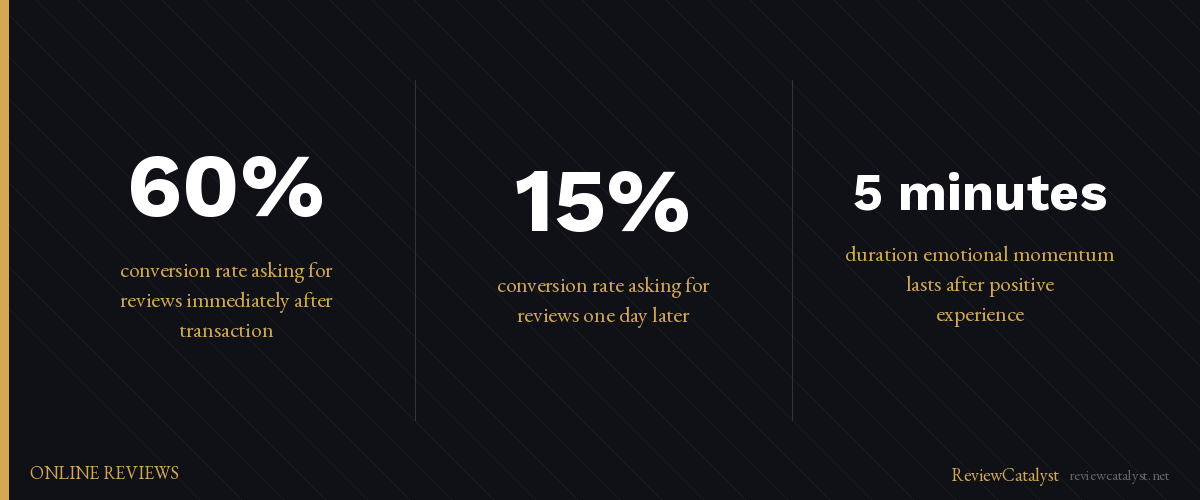
This is why timing matters so much. The emotional momentum of a great experience lasts about 5 minutes. After that, the emotional charge fades and the friction of reviewing becomes more real than the reason to review.
Your job isn’t to convince people to review. It’s to remove the obstacles between the moment they’re happy and the moment the review goes live.
The Psychology of Review-Leavers vs. Review-Avoiders
Research on review behavior shows consistent patterns. People leave reviews when:
- The experience was memorable — either very good or very bad
- The ask feels personal, not transactional — a real human asking, not a mass email
- It takes seconds, not minutes — one click beats a form with fields
- They’re asked immediately — while the emotion is fresh
- They’ve already opted in — they said yes to hearing from you
People skip reviews when the timing is wrong. When the process feels complicated. When they weren’t directly asked. When they don’t know where to find your review page. When they have to choose between multiple platforms.
The gap between these two lists is where your system lives. Every barrier you remove pushes more customers from the “skip” column to the “review” column.
The Specific Moments When Customers Are Most Likely to Review
Right after the transaction is the golden window. A customer just walked out of your salon, their hair looks great, they’re happy. In that moment, asking them to review is a 60% conversion. Ask them tomorrow and it drops to 15%.
This is why timing matters more than the channel. A request that reaches customers in the moment they’re happy — whether via SMS, QR code, or in-person ask — will convert far more reviews than one that arrives days later. The emotional momentum of great service lasts minutes, not hours.
Emotion is your leverage. Customers don’t review neutral experiences. They review experiences that felt good or bad enough to remember. The stronger the feeling, the more likely they are to act. A great haircut? Maybe. A transformation that made them feel confident? Definitely.
Easy asks win. A one-step process beats a multi-step process. Every extra step loses half your customers.
How to Structure Your Ask So More Customers Say Yes
The most effective review asks share three characteristics:
1. They happen in the moment. Not days later. Not via a random email you sent months ago. Now. While they’re happy.
2. They require minimal friction. A link in a text message. A QR code to scan. Not “go to Google and search for us.”
3. They feel personal. Even if it’s automated, it should feel like it came from a person who cares, not a marketing machine. This is why SMS and in-person asks outperform generic email blasts.
When these three elements align, your review rate climbs dramatically. When they’re missing, you get the silence most businesses experience.
Common Mistakes That Kill Your Review Rate
Asking too late. The biggest mistake small businesses make is asking for reviews days or weeks after the transaction. By then, the emotion is gone and the friction feels heavy. The customer has moved on.
Making it complicated. Sending an email with five paragraphs followed by a link that requires them to find the business themselves doesn’t work. One text with one link that takes them directly to the form does.
Asking the same way every time. Some customers respond to SMS. Others check email. Some prefer to scan a QR code. A one-channel approach will always miss people. Multiple options catch more reviews.
Not following up. One ask rarely gets the job done. Customers forget, ignore, or defer. A consistent sequence of asks — two or three over time — builds momentum without feeling pushy.
Building a System So Your Customers Actually Review
Automation changes everything. When you stop asking manually and start asking systematically, three things happen:
- Timing becomes reliable. The request goes out at the moment it matters most — not when you remember.
- Frequency becomes consistent. You’re not relying on willpower. Every qualified customer gets asked, every time.
- Friction disappears. With SMS or QR codes, customers go from happy to reviewed in seconds.
ReviewCatalyst removes the guesswork. SMS sends automatically at the moment customers care most, QR codes make the ask instant at point of service, and every request lands on a branded feedback page — no account creation, no hunting for your business on Google. One link. Every option. From there, customers choose their preferred platform, leave private feedback, or share a testimonial. No friction. More reviews.
Every week you don’t have a system, you’re watching customers who love you leave without leaving a trace. ReviewCatalyst removes the friction — SMS sends at the moment customers care most, QR codes make it a one-second ask, and AI responses turn every review into a relationship-builder. Try it free for 14 days at reviewcatalyst.net — no credit card required.
Ready to get more reviews on autopilot?
ReviewCatalyst sends review requests via SMS automatically — no manual follow-up, no chasing customers.
Start Free Trial