How to Increase Your Google Star Rating from 3 to 4+ Stars
A half-star difference between you and a competitor on Google Maps means the difference between getting the click or losing it. That gap is costing you customers right now.
If your rating is stuck at 3.0 or 3.5 stars, you’re bleeding customers to competitors with 4.5+ stars—every single day. The frustrating part? You probably have plenty of satisfied customers. They just aren’t leaving reviews.
Here’s the good news: raising your rating from 3 to 4+ stars is math, not magic. It takes a system. It takes consistency. But it absolutely works.
Why Your Google Star Rating Matters More Than You Think
Your Google star rating is the first thing potential customers see—before they click on you, before they call, before they visit your website. On Google Maps, it’s the biggest visual signal. On Google Search, it appears right next to your business name.
That rating isn’t just a number. It’s your most powerful marketing asset. It builds trust with strangers who know nothing about you except what other customers say.
Here’s the brutal part: one or two negative reviews from years ago can tank your entire rating. If you’ve been coasting on word-of-mouth, you probably haven’t been asking for reviews consistently. So the only reviews you have are from the occasional unhappy customer or the rare super-fan who leaves one unprompted.
That’s why your rating feels stuck.
The Real Reason Your Rating Is Stuck at 3 Stars
You already know why, deep down. It’s one of these three things:
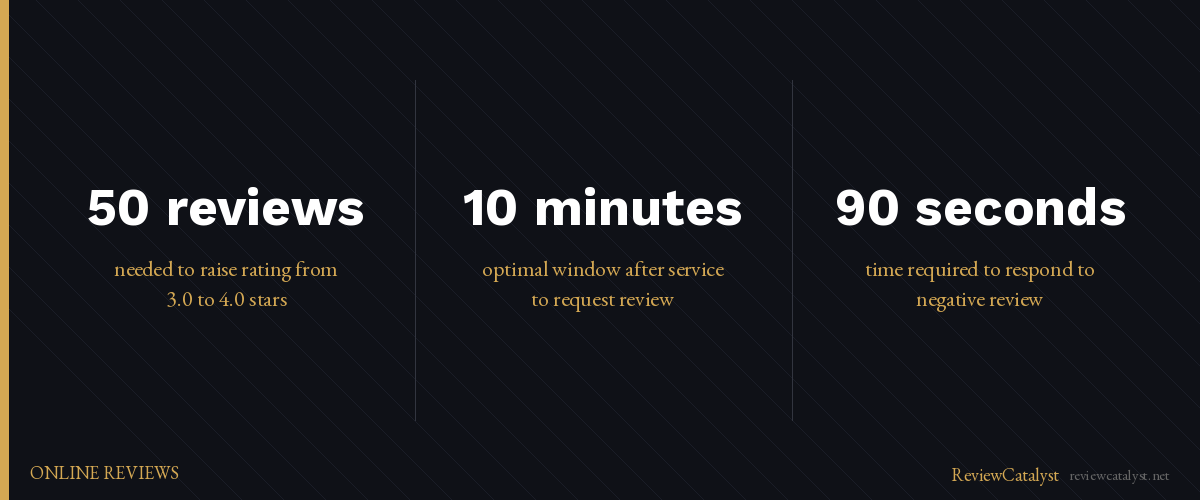
You’re not asking for reviews at all. Most business owners ask sporadically. The problem: customers say yes in the moment and never follow through. You’re not asking at the right time. The best moment to capture a review is in the 10 minutes after service ends—while they’re still thinking about you. Wait a week, and the emotion fades. Ask in person without a link, and you get a verbal “sure” and nothing more.
You’re asking, but only sometimes. You remember to ask after the big project or the great appointment, but you skip it when you’re busy. Consistency is everything. One customer per week means 52 reviews per year. One customer per month means 12. The difference compounds.
You’re getting negative reviews and doing nothing about them. Silence makes it worse. When a customer leaves a 2-star or 3-star review and you don’t respond, Google treats that as a signal the complaint is valid. Other customers see the negative review and no response—and assume you don’t care.
Step 1: Stop Asking for Reviews Ad Hoc
Asking for reviews manually doesn’t work. It relies on your memory, your energy level, and your willingness to keep asking.
Timing is everything. The best moment to ask for a review is right after the service or sale—when the customer is most satisfied and most likely to take 60 seconds to leave feedback.
Text messages beat email for reviews. Customers read them in minutes, not hours or days. The response is immediate. For local service businesses especially, SMS is the fastest way to get reviews while customers are still in the moment.
But here’s the catch: SMS has to be automated, or it’s just another manual task on your to-do list.
Step 2: Ask Every Customer, Not Just the Ones You Remember
This is the real lever: consistency at scale.
Instead of asking when you remember, you need a system that asks every customer. Here’s how:
-
Get your customer contact info. If you use a booking system, CRM, or even just a spreadsheet, you already have this. If not, start collecting phone numbers at checkout or after service. Many businesses use a simple QR code that adds customers to their review request list automatically.
-
Set up automated requests. Once you have a list, a review request goes out the same day or the next morning, depending on your preference. You don’t have to think about it. Every customer gets asked.
-
Use QR codes for in-person businesses. If customers are in your store, salon, office, or car, a printed QR code on your receipt or counter is the fastest ask. They scan it in 3 seconds and leave a review right there—before they forget.
The result: Instead of asking 2–3 customers per week, you’re asking 20–30. That’s 100 reviews per year instead of just 12.
Step 3: Respond to Every Negative Review—Fast
Here’s what most businesses get wrong about negative reviews: responding doesn’t delete them. Your goal isn’t to make the review disappear. It’s to show other customers that you care about feedback and you fix problems.
When you respond professionally to a negative review, Google’s algorithm notices. More importantly, future customers see that you address complaints. That turns a liability into proof of your customer service.
How to respond:
- Address the specific complaint, not the emotion. Don’t get defensive.
- Apologize sincerely.
- Offer a solution or invite them to fix it offline.
- Keep it short (2–3 sentences).
Example: “We’re sorry your experience fell short. This isn’t typical for us, and we’d like to make it right. Can you reach out to us at [phone/email] so we can talk?”
This takes 90 seconds per review. If you respond to every negative review within 24 hours, you signal to Google and to customers that you’re active and you care.
Step 4: Get Your Positive Reviews Working Harder
Positive reviews shouldn’t just sit on Google. They should be working for you on your website.
Embed a live review feed widget on your homepage. Let visitors see real customer feedback before they call. Positive reviews on your website build trust faster than almost anything else—they’re proof from real customers that you deliver.
Also ask for testimonials, not just star ratings. A written testimonial (“Best experience I’ve had—staff was incredible”) is more powerful than a 5-star rating alone. It gives future customers specifics.
How Long Does It Take to Go from 3 to 4+ Stars?
Here’s the math:
If your current rating is 3.0 stars and you have 50 reviews total, raising it to 4.0 stars takes roughly 50 more 5-star reviews (assuming your current reviews stay the same). At one review per week, that’s a year. At five reviews per week, that’s 10 weeks.
The timeline depends entirely on your volume. Most businesses see movement within 60–90 days of consistent asking. You won’t jump overnight, but you’ll see the rating climb steadily.
The System That Makes This Work
You can do all of this manually. You can text customers one by one, track who you’ve asked, respond to each review individually, and manually embed reviews on your website. Most businesses do. And most never reach 4+ stars because the work is endless and inconsistent.
Or you can use a system that automates the asking, centralizes the responses, and handles the rest. ReviewCatalyst sends review requests automatically via SMS or QR code, lets you respond to every review in one dashboard, and embeds live reviews on your website—all without you lifting a finger after setup.
The difference between a 3-star and 4-star business is often just consistency. A system makes consistency automatic.
A 3-star rating costs you real customers every month. ReviewCatalyst automates the review requests that turn customers into raters—so you’re not chasing reviews manually. Try it free for 14 days at reviewcatalyst.net. No credit card required.
Ready to get more reviews on autopilot?
ReviewCatalyst sends review requests via SMS automatically — no manual follow-up, no chasing customers.
Start Free Trial