What to Do When a Customer Leaves a Fake Negative Review on Google
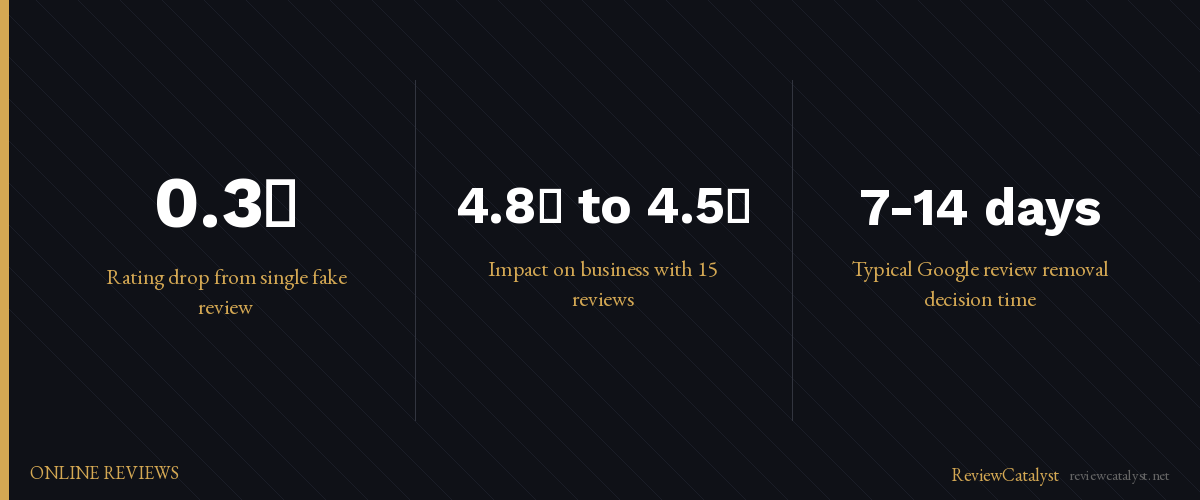
A single fake 1-star review from someone who was never your customer can drop your Google rating by 0.3 points. For a business with 15 reviews at 4.8 stars, that one fraudulent review tanks you to 4.5 — enough to noticeably hurt your visibility in local search and cost you real clicks. That’s not a minor annoyance. That’s revenue.
The worst part? You know it’s fake. You know who wrote it (or at least, you know they were never a customer). But Google doesn’t always see it that way.
Here’s what to do about it.
How Google Decides a Review Is Actually Fake
Google removes reviews for specific reasons — and “I think this is fake” isn’t one of them. You need to understand what Google actually looks for.
Signs Google looks for
Google’s system flags reviews for removal when they:
- Come from an account with no purchase or service history with your business
- Use language that clearly indicates the reviewer was never a customer (e.g., “I’ve never been here but…” or reviews that describe your business incorrectly)
- Violate Google’s review policies explicitly (profanity, threats, spam, defamatory claims)
- Are part of a pattern — multiple fake reviews from coordinated accounts
- Come from a competitor or involve clear evidence of sabotage
A review that simply says “bad service” from someone you’ve never heard of? That’s harder to prove as fake, even if you know it is.
What Google won’t remove
Google is cautious about removal because it doesn’t want businesses flagging negative reviews as “fake” just because they sting. They require solid evidence. A review that is negative but plausible usually stays, even if you suspect it’s fraudulent.
This is frustrating. But it also protects your business — because your legitimate negative reviews can’t be removed just because they hurt.
Step-by-Step: How to Report a Fake Review to Google
Here’s the process that actually works.
Before you report: Document everything
Before you file a report, gather evidence:
- Take screenshots of the review (date, time, reviewer account)
- Note whether the reviewer’s account looks suspicious (new account, no profile picture, no other reviews)
- Check your records: do you have any transaction history, appointment booking, or purchase record from this account or email?
- If you recognize the person, note any context (competitor, disgruntled employee, ongoing dispute)
This documentation strengthens your report and helps Google’s team evaluate it faster.
The reporting process
- Go to your Google Business Profile
- Navigate to the Reviews section
- Find the fake review and click the three-dot menu next to it
- Select Flag as inappropriate
- Choose the reason that best fits: Inappropriate content, Off-topic, Conflicts of interest, or Spam/Fake reviews
- Add a brief explanation in the comments box — be specific about why you believe it’s fake
- Submit the report
That’s it. You don’t need to provide extensive proof, but specificity helps. Instead of “This is fake,” write: “This reviewer has no transaction history with us. Our records show no appointment or purchase under this name or account.”
What to expect after you report
Google’s team reviews the report. They don’t tell you the outcome and don’t provide a timeline. Most decisions take 7–14 days, but it can be longer.
Important: Google does not always agree with you. Even if you reported the review, it may stay up. This doesn’t mean your report was ignored — it means Google evaluated the review against their policies and decided it didn’t clearly violate them.
How long removal takes
If Google does remove the review, it can take anywhere from a few hours to several days. Your rating updates automatically once the review is gone.
Why Google Sometimes Won’t Remove It
Here’s the hard truth: if the review doesn’t violate Google’s specific policies, it stays. A review that says “terrible experience, never coming back” from an account you’ve never seen is negative, but not provably fake by Google’s standards.
The gray area: negative reviews that feel fake but aren’t
Sometimes a review feels fraudulent because:
- You don’t recognize the person, but they could be a one-time customer, referred by someone else, or paid cash
- The details are vague, which is also just how some people write reviews
- The timing is suspicious, though it could be coincidence
Unless you have hard evidence — the account is brand new, the details are demonstrably false, or the language proves they were never a customer — Google won’t remove it.
When a bad review is legitimate, even if it stings
Some negative reviews come from real customers who had a real bad experience. Those aren’t fake. And they stay.
The best defense isn’t fighting them one at a time. It’s building enough review volume that one or two negative reviews don’t tank your rating.
While You Wait for Google to Respond
Don’t sit idle.
Respond to the review professionally. Other customers reading that fake review will also read your response. A calm, factual reply like “We have no record of this transaction and would welcome the chance to help. Please reach out at [number]” does two things: it tells potential customers you stand behind your work, and it shows you’re not the type to ignore criticism. That matters more than the fake review itself.
Ask happy customers for reviews. A fake 1-star review does far less damage if you have 30 five-star reviews coming in. Start reaching out to customers you know had great experiences and ask them to leave a review. The more real reviews you have, the less impact the fraudulent one carries.
Monitor for patterns. Is this a one-off, or are you seeing multiple suspicious reviews? If it’s a pattern, document it and mention it in future reports to Google.
How to Prevent Fake Reviews in the First Place
Here’s what most businesses miss: fake reviews hurt far less when you have a steady stream of real ones.
A business with 200 five-star reviews isn’t damaged by one fake 1-star review. The rating barely moves. But a business with 15 reviews? That one fraudulent review has devastating impact.
The long-term defense is consistency. Ask your customers for reviews after every service or transaction. Not just the happy ones — all of them. When you’re consistently getting new reviews, fraudulent ones become statistically irrelevant.
Systems like ReviewCatalyst automate this. SMS and QR codes send review requests automatically after every service. The result: a steady stream of real reviews that makes your business fraud-proof. A competitor trying to tank you with fake reviews will fail because your legitimate review volume is too strong.
One fake review on a business with 200 real ones is just noise. On a business with 15? It’s a catastrophe.
The Real Solution
The real protection against fake reviews is simple: you can’t be hurt by one fraudulent review if you’re consistently getting real ones. Every week without a review system is a week your reputation stays vulnerable. ReviewCatalyst automates the ask — SMS and QR codes send review requests automatically after every service — so you build review volume fast enough that fake reviews become statistically irrelevant. Start your free 14-day trial at reviewcatalyst.net — no credit card required.
Ready to get more reviews on autopilot?
ReviewCatalyst sends review requests via SMS automatically — no manual follow-up, no chasing customers.
Start Free Trial