Why Your Google Review Rating Dropped and How to Fix It
A single bad review can shift your Google rating. Lose five or more recent reviews in a month, or get hit with a cluster of low ratings? Your average can drop noticeably — enough that you’ll see fewer clicks from Maps, fewer new customer calls, and your competitors with better ratings pulling ahead.
If your rating just fell, you’re not imagining it. Here’s what happened and what to do next.
Why Your Google Rating Dropped (The 5 Main Reasons)
You Got a Cluster of Low-Star Reviews
This is the most common reason. Maybe you had a rough week — a service mishap, staffing issues, or one unhappy customer who left a 1 or 2-star review. If that happened within days of other low ratings, the damage adds up fast.
Google prioritizes recent reviews because they matter more to how your business operates today. A 1-star review from last week tells potential customers more about your current service than one from six months ago. When you get three or four low ratings in a 10-day stretch, that spike does more damage to your average than the same reviews spread across the year.
Recent Negative Reviews Hit Harder (Timing Is Everything)
Google surfaces recent activity prominently. A cluster of low ratings in the past 2–3 weeks will drop your average faster than the same reviews scattered across six months.
Three customers leaving 2-star reviews in the past 10 days? That’s a bigger hit than if those same reviews landed one per month over the past quarter. This is why one bad week can feel like a sudden collapse.
You Lost Reviews (Deleted or Reported as Spam)
Sometimes your rating drops because reviews disappeared, not because new bad ones arrived.
Google removes reviews that violate its policies: fake reviews, spam, off-topic posts. If several of your reviews got removed in the past month, your total count drops and your average shifts. A business with 50 reviews at 4.8 stars looks stronger than one with 45 reviews at 4.7 stars, even if the removed reviews weren’t your lowest-rated ones.
Fewer Positive Reviews Than Usual
A dropped rating doesn’t always mean more bad reviews. It often means fewer good ones.
If you normally get 8–10 reviews per month but only got 2–3 this month, your lower-rated reviews become more visible, dragging down your average. One 2-star review matters less when you have ten 5-stars to balance it. That same 2-star review matters much more when you only have two 5-stars.
Google Algorithm Changes (Rare, But It Happens)
Occasionally Google updates how it calculates or displays ratings. Google also filters reviews it deems less reliable based on the reviewer’s account history. If several of your positive reviews were filtered out, your visible average changes. Check your review count in Google Business Profile. A significant drop means you’ve likely lost reviews to Google’s filtering system.
How Much Does One Bad Review Actually Hurt?
Let’s do the math.
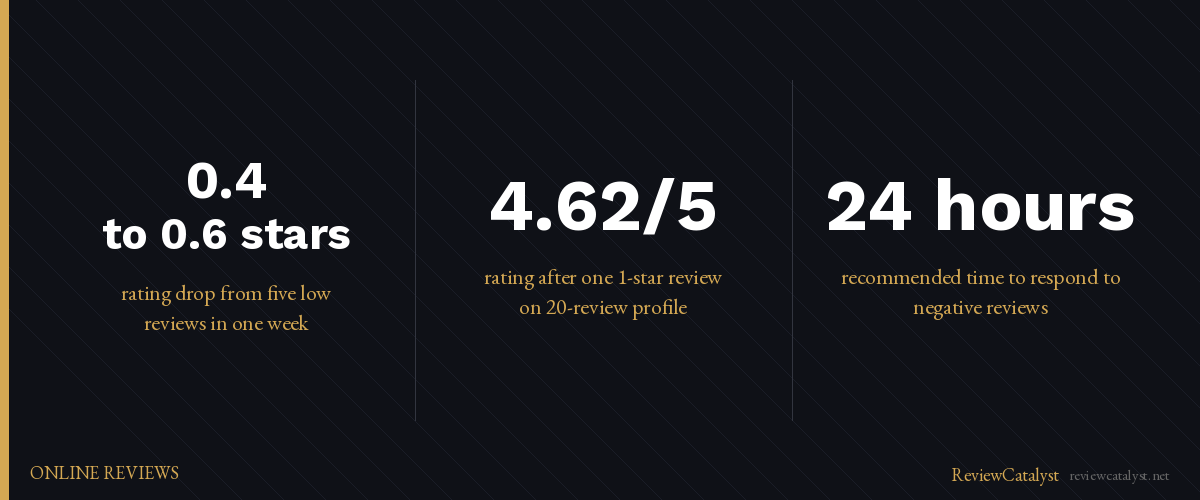
If you have 20 total reviews averaging 4.8 stars, that’s about 96 star points total (20 × 4.8). One new 1-star review brings you to 21 reviews and 97 star points—which calculates to 4.62 stars. That’s a real drop from a single review.
Now imagine five 2-star reviews land in one week. Depending on your starting average, you could see a drop of 0.4 to 0.6 stars. That’s visible to every potential customer checking your Maps listing.
How to Fix a Dropped Google Rating (4 Steps)
Step 1 — Respond to the Negative Review(s) Right Away
A response won’t erase the low rating, but it shows potential customers you care and actively manage feedback. Respond within 24 hours if possible.
Stay professional, non-defensive, and focused on solutions. Acknowledge the issue, take responsibility where appropriate, and offer a specific way forward. Many readers will see both the bad review and your response, which builds trust even if the original rating was low.
Step 2 — Find Out Why the Drop Happened
Open your Google Business Profile and check:
- Review count: Did it go down? That means reviews were removed.
- Recent reviews: Look at the past 2–3 weeks. How many 1–2 star reviews appeared?
- Rating trend: Google shows how your average has changed over time. Was it a sharp drop or gradual?
This tells you whether you’re dealing with a service problem, a bad week, or a loss of positive reviews. Different problems need different solutions.
Step 3 — Fix the Problem Behind the Bad Reviews
Read the negative reviews carefully. What are they saying? Is there a pattern—lateness, quality issues, customer service? Or are these isolated incidents?
Address the root cause. If multiple people complained about wait times, you have a process problem that needs fixing. If one person had a bad experience, it might have been a one-off. Either way, fix the operational issue first. A low rating from a legitimate complaint is valuable feedback.
Step 4 — Start Asking for More Positive Reviews (Consistently)
This is the long-term fix. More positive reviews means a higher average. If your rating dropped from 4.8 to 4.5 because of five low reviews, five more 5-star reviews brings you right back up.
The key is consistency. Most businesses ask for reviews sporadically—they remember after a great interaction, then go three weeks without asking anyone. That inconsistency leaves you exposed. When bad reviews hit, you don’t have enough positive ones in the pipeline to offset them.
How to Prevent Your Rating From Dropping Again
Automate Review Requests Instead of Asking One at a Time
Here’s the simple fix: set up one system that asks every customer, every time, without you having to remember.
SMS texts, email, QR codes—whatever fits your business—one consistent process replaces scattered, random asks. You request a review after every service or purchase. Customers respond while the experience is fresh. Positive reviews come in steadily. Your rating stays protected against the occasional bad one.
Check Your Reviews Weekly, Not Monthly
Don’t wait for the surprise. Look at your rating and new reviews at least once a week. You’ll catch bad reviews early and spot trends before they tank your average. If three similar complaints show up in two weeks, you can fix the problem before it becomes five complaints.
Respond to Every Review Within 24 Hours
A review with a response looks managed and professional. Potential customers see it and trust you more, even if the review itself was negative.
Fix Service Issues Before They Become 1-Star Reviews
The best prevention is straightforward: deliver consistent service. When you’re asking for reviews regularly, you’re also collecting real feedback about what’s working and what isn’t. Use that data to improve.
The Bottom Line
A dropped rating is a wake-up call, not a disaster. It tells you either that you had a rough week or that you need more review volume to stay protected.
Fix the immediate problem—respond to bad reviews, identify what went wrong, and address it. Then build a system that prevents the next drop. Every week without a consistent review process is a week your rating stays vulnerable.
ReviewCatalyst automates review requests so positive reviews keep flowing and your rating stays protected. Try it free for 14 days at reviewcatalyst.net. No credit card required.
Ready to get more reviews on autopilot?
ReviewCatalyst sends review requests via SMS automatically — no manual follow-up, no chasing customers.
Start Free Trial