How to Ask Customers for Google Reviews Without Feeling Pushy
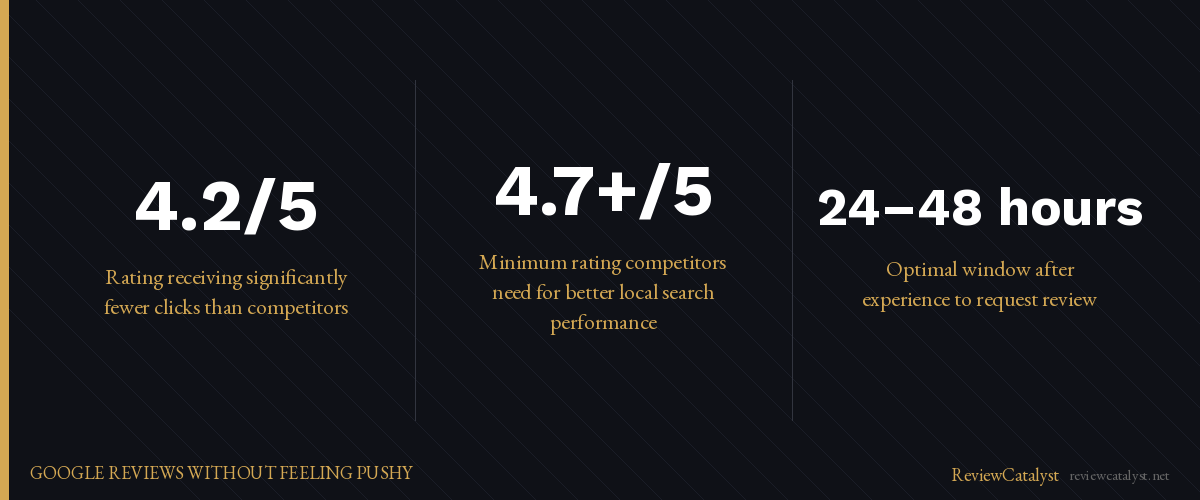
A business with a 4.2-star rating gets significantly fewer clicks than competitors with 4.7+ stars in local search — but most owners never ask a single satisfied customer for a review.
The reason? Guilt.
Most business owners feel uncomfortable asking. They don’t want to seem desperate. They don’t want to interrupt the customer experience with a sales pitch. And honestly, they don’t have a clear system for when or how to ask without feeling transactional.
So they don’t ask at all.
Then they wonder why their rating stagnates while a competitor across town moves to 4.8 stars.
The truth: your instinct to avoid being pushy is exactly right. But your solution so far — asking sporadically or not at all — is worse than asking consistently and tactfully.
Here’s what actually works.
Why You Feel Pushy When Asking for Reviews (And Why You Shouldn’t)
The guilt you feel when asking for a review isn’t a sign you shouldn’t ask. It’s a sign you care about the customer experience. That’s the opposite of pushy.
Most people are happy to leave a review for a business they genuinely liked. They don’t see it as a favor. They see it as honest feedback that helps other people. The real problem isn’t being asked — it’s that customers don’t know where to leave a review, can’t remember which platform your business is on, or have to hunt through Google to find you.
When asking feels pushy, it’s usually because you’re asking at the wrong time or you’re not making the next step obvious.
The Timing Question — When to Actually Ask
The best window is 24–48 hours after the experience.
Why? The experience is still fresh enough that customers remember the details, but enough time has passed for them to reflect. A contractor asking you for a review the moment they finish the job feels transactional. A text the next day — after you’ve had time to live with the work — feels genuine.
Ask too soon and it feels like you’re chasing. Ask at the right moment and it feels like you actually want their honest feedback.
For appointment-based businesses (salons, dental, auto repair), ask within 24 hours after they leave. For field-based businesses (contractors, landscapers), ask after the work is done and they’ve had a full day with it. For retail or food service, ask while they’re still in a good mood — within hours, before the experience fades.
One exception: If a customer had a problem that you just fixed, wait 48+ hours before asking. Let them verify the solution actually works.
Three Ways to Ask That Don’t Feel Pushy
Method 1: The in-person ask (salons, restaurants, retail, field services)
Hand them a card with a QR code or URL and say: “We’d love to hear your feedback. Scan that whenever you get a chance—you can share your review on Google, Facebook, or wherever you prefer.”
This is casual and puts the choice in their hands. No pressure.
Method 2: The text message ask (appointments, services)
Send one text within 24–48 hours: “Thanks for coming in yesterday. If you were happy with your experience, we’d love to hear about it. [link]”
Texts get opened fast. They’re personal without being pushy.
Method 3: The email ask (online businesses, e-commerce)
A follow-up after purchase: “We’d appreciate your honest feedback. Here’s a link to share your experience.”
Email gives people time to think without demanding an instant response.
What to Say — Language That Works
A good review request has four parts:
- A genuine thank you
- One clear ask
- One link
- No pressure
Here’s what works:
Text: “Thanks for coming in yesterday. If you were happy with your experience, we’d love to hear about it. [link]”
In-person card: “We’d love your feedback. Scan this code whenever you get a chance.”
Email: “We’d appreciate your honest feedback about your recent experience. [link]”
The key: one link, one click. When customers land on it, they should see multiple platform options — not be forced down one path.
What NOT to say:
Don’t ask them to find you on Google manually. This adds work.
Don’t mention “5-star” or hint at a specific rating. It feels like you’re asking them to fake it.
Don’t thank them for a positive review before they’ve left one. This looks manipulative.
Don’t send generic blasts. Personalization matters.
The Secret Most Owners Miss: Make It Effortless
When your customer clicks your link, they should land on a page with platform choices.
Not “leave a review on Google.” Just: Google, Facebook, or other options.
Some customers prefer Google. Others like Facebook. Some prefer industry-specific sites. When you give them choice instead of forcing one destination, it doesn’t feel like you’re harvesting reviews. It feels like you actually want their input.
One link. Multiple platforms. No friction.
How to Stop Asking Ad-Hoc and Start Getting Reviews Consistently
Most small business owners feel uncomfortable asking because they do it sporadically. One month they remember. The next month they forget. Some customers get asked. Others don’t.
The system that works is automated requests sent at the right time.
You set a schedule — after every appointment, after every service, after every project — and requests go out automatically with a real link. Customers don’t know it’s automated. They just experience a business that asks for feedback naturally and at exactly the right moment.
This is the difference between a 4.2-star business and a 4.8-star one. Not better luck. Not better customers. Just consistency.
Every week without a system for asking is a week your competitors pull further ahead. ReviewCatalyst automates the timing and sends requests when customers are most likely to respond — without any pushiness. Try it free for 14 days at reviewcatalyst.net. No credit card required.
Ready to get more reviews on autopilot?
ReviewCatalyst sends review requests via SMS automatically — no manual follow-up, no chasing customers.
Start Free Trial