How Many Google Reviews Do You Need to Rank in the Local Pack?
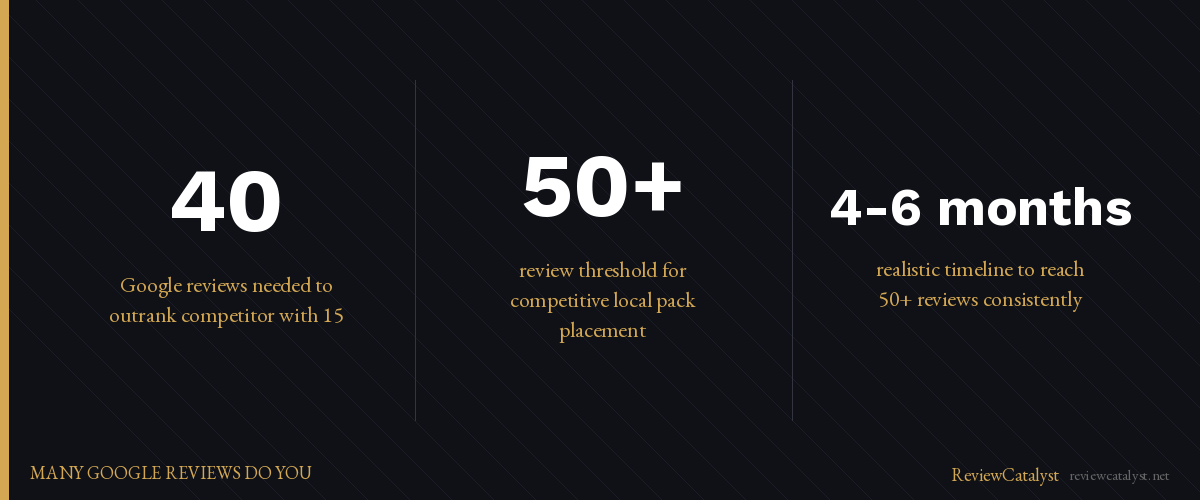
A business with 40 Google reviews will almost always outrank a competitor with 15 — but only if the rating is competitive. Here’s the real formula Google uses, and what it means for your business.
If you’ve ever wondered whether your review count is “enough” to compete locally, you’re not alone. Most business owners assume there’s a magic number. There isn’t. But there is a threshold, and understanding it could be the difference between appearing in the local pack or getting buried on page three.
The Short Answer: Review Count + Rating + Recency
Google’s local ranking algorithm doesn’t publish a formula, but the pattern is clear: review count matters, but it’s never the only factor.
Three things typically work together for a business that ranks well locally:
- A solid review count — usually 20+ to compete
- A strong rating — 4.5+ stars is standard in competitive industries
- Recent reviews — consistent activity in the last 30-90 days signals you’re still in business
Miss any one of these, and you lose ground.
Why Google doesn’t publish a magic number
Google keeps its local ranking algorithm private on purpose. If there were a hard rule like “you need 50 reviews to rank,” every business would just buy them. Instead, Google treats review activity as a signal of legitimacy and customer happiness — it’s one of dozens of factors that include location, citations, website content, and how you engage with customers.
What the data actually shows
Businesses in the top three local results typically have significantly more reviews than businesses on page two — but how much more depends heavily on your industry and how crowded your local market is.
How Many Reviews You Really Need
Here’s where most businesses get stuck: they see a competitor with more reviews and assume that’s the reason they’re outranked.
It’s not that simple. Here’s what actually happens:
0–20 reviews: The visibility gap
You’ll show up in searches from people very close to you, and you might appear in “more places” results. But you’re not competitive yet. You need to move past this stage.
21–50 reviews: Breaking into the local pack
This is where momentum kicks in. A business with 35 reviews and a 4.6-star rating will typically beat out a competitor with 80 reviews but a 4.2 rating. Google is watching whether you’re actively building reviews.
50+ reviews: The competitive threshold
Once you reach 50+ recent reviews with a solid rating, you can compete for top three placement in most markets. You’ve signaled consistency and customer satisfaction at scale.
100+ reviews: Dominant positioning
A business with 100+ recent reviews and a 4.7+ rating is hard to dislodge. Even newer competitors with higher ratings struggle to outrank them.
Why Review Count Alone Won’t Get You to Rank
Here’s what matters: a competitor with more reviews but a lower rating can still lose to you.
Google doesn’t just count reviews — it reads them.
Your star rating matters more than raw count
A 4.8-star rating with 30 reviews often outperforms a 4.2-star rating with 80 reviews. Why? Because a lower rating signals customer dissatisfaction, no matter how many reviews back it up. That hurts your ranking.
Review velocity — how fast you’re building
A business getting three reviews a week looks active and growing. A business that got 50 reviews once and then nothing for months looks stalled. Google rewards momentum. One steady review per week beats ten reviews dumped all at once three months ago.
Reviews spread across platforms
Reviews on Google, Facebook, and industry-specific sites send a stronger signal than reviews concentrated only on Google. Google notices.
Everything else matters too
Review count is one signal in a larger mix. Google also looks at:
- Location accuracy — correct address, verified hours, complete business info
- Citations — how often your business shows up mentioned on other websites
- Website relevance — whether your website content matches what people search for in your area
- Customer engagement — how quickly you respond to reviews, your Q&A activity
A business with 25 solid reviews, accurate citations, and relevant website content will outrank a business with 75 mediocre reviews and weak local SEO.
The thing Google actually reads: review quality
Google’s AI doesn’t just look at star ratings. It reads the actual text.
A review that says “Best service in town. Fixed my car in one day and charged fair prices. Highly recommend” carries more weight than fifty reviews that just say “Good.”
Detailed reviews with relevant details give Google real information about what your business does well. They help your ranking.
How to Close the Review Gap Fast
If you’re behind your competitors, the answer isn’t patience — it’s consistency.
Most businesses ask for reviews when they remember, or only from customers they think will leave five stars. Then they wonder why they’re stuck at 12 reviews while competitors have 60.
A realistic timeline: If you’re at 15 reviews with a 4.6 rating, you can reach 50+ reviews in 4-6 months by asking every customer consistently — not just the ones you’re confident about.
ReviewCatalyst automates the asking part. Instead of manually texting or emailing customers one by one, you set up review requests once and send them consistently via text, email, or QR code. No forgetting. No burnout. This consistency is what moves businesses from 20 reviews to 50+ reviews in a few months.
Action: Your 90-Day Review Growth Plan
Month 1: Get to 20+ reviews by asking every customer. Use a QR code at the register or text message if you have phone numbers.
Months 2-3: Aim for 2-3 reviews per week. Respond to every review — good or bad — within 24 hours.
Track: Watch your rating, review count, and ranking position weekly. If your rating dips, adjust how you’re asking or who you’re reaching out to.
Most businesses stay stuck at 20–30 reviews because they ask sporadically. ReviewCatalyst removes that friction — every customer gets asked consistently, automatically, without you lifting a finger. That’s how you build the review count and velocity Google actually rewards. Try it free for 14 days at reviewcatalyst.net — no credit card required.
Ready to get more reviews on autopilot?
ReviewCatalyst sends review requests via SMS automatically — no manual follow-up, no chasing customers.
Start Free Trial