How to Respond to Negative Google Reviews Without Making It Worse
A single poorly written reply to a negative Google review can cost you far more customers than the review itself.
Think about it: A frustrated customer leaves a 1-star review complaining about your service. That’s one person’s opinion. But when you fire back defensively, make excuses, or ignore them entirely, everyone reading your Google Business Profile sees it. And they’re reading your response more carefully than they read the original review.
Your reply is your chance to show every potential customer watching that you care, that you listen, and that you’re the kind of business worth trusting. Mess it up, and you’ve just validated the negative review in front of dozens of people who were still on the fence about you.
The good news: a professional, thoughtful response is learnable. You don’t need to be a PR expert. You just need a system.
Why Your Response Matters More Than the Review Itself
The review is one person’s opinion. Your response is visible to everyone else.
When someone leaves a bad review, potential customers don’t assume it’s gospel. They assume it’s one person’s experience. What they do pay close attention to is how you handle it.
A customer reading your Google profile is asking themselves: “If something goes wrong with me, how will this business treat me?” Your response to that negative review is the answer.
A bad reply signals bigger problems. If you respond defensively, blame the customer, make excuses, or don’t respond at all—you’re telling everyone else: “We don’t take feedback seriously. We don’t care what customers think. We won’t fix problems.”
A calm, professional, empathetic response says the opposite: “We listen. We own our mistakes. We’ll make it right.”
That distinction moves the needle on whether someone calls you or picks your competitor instead.
The 4-Step Formula for a Response That Defuses
Step 1: Wait 24 Hours (Don’t Reply Angry)
Your first instinct when you read a negative review is often to fire back immediately. Don’t.
You’re emotional. The reviewer is emotional. Responding in that state guarantees you’ll sound defensive, dismissive, or worse—angry. Sleep on it.
Read the review again the next morning with fresh eyes. You’ll spot opportunities to acknowledge the customer’s frustration without admitting fault you don’t owe them.
Step 2: Acknowledge the Problem (No “But”)
Start your response by acknowledging what the customer experienced, not by explaining why they’re wrong.
Say: “I’m sorry your recent visit didn’t meet your expectations.”
Don’t say: “We’re sorry you felt that way, but our staff was actually following protocol.”
See the difference? The first one validates their experience. The second one minimizes it. The word “but” immediately tells the reader you’re about to make excuses.
Even if you believe the customer is wrong or exaggerating, acknowledge their experience first. You can clarify facts later, but only after they feel heard.
Step 3: Take It Offline (Give Them a Direct Contact Method)
This is where most business owners go wrong. They try to solve the problem in the public reply.
Don’t do that. A public comment thread is the worst place to negotiate a resolution.
Instead, use your response to invite the customer to contact you directly:
“I’d genuinely like to understand what happened and make this right. Please reach out to me directly at [email] or [phone number], and we’ll take care of this.”
This does three things: It shows other readers you’re willing to go the extra mile. It gets the problem-solving conversation off the public stage. And it gives the customer a face-saving way to resolve the issue privately.
Step 4: Close With a Solution or Invitation
End on a forward-looking note. Either offer a specific solution (if you know what would make it right) or invite them back to give you another chance.
“We’d love the opportunity to do better. Please let me know how I can make this right.”
Or: “Your feedback helps us improve. I hope you’ll give us another chance.”
This signals to everyone reading that you’re not just defending yourself—you’re genuinely invested in making the customer happy.
What NOT to Do (Common Mistakes)
Don’t be defensive or argue with the customer. Even if they’re 100% wrong, arguing in public makes you look bad. Calm, professional, and slightly humble wins every time.
Don’t make excuses. “Our staff was understaffed that day” or “we were going through a system update” might be true, but it sounds like you’re blaming circumstances instead of owning the problem.
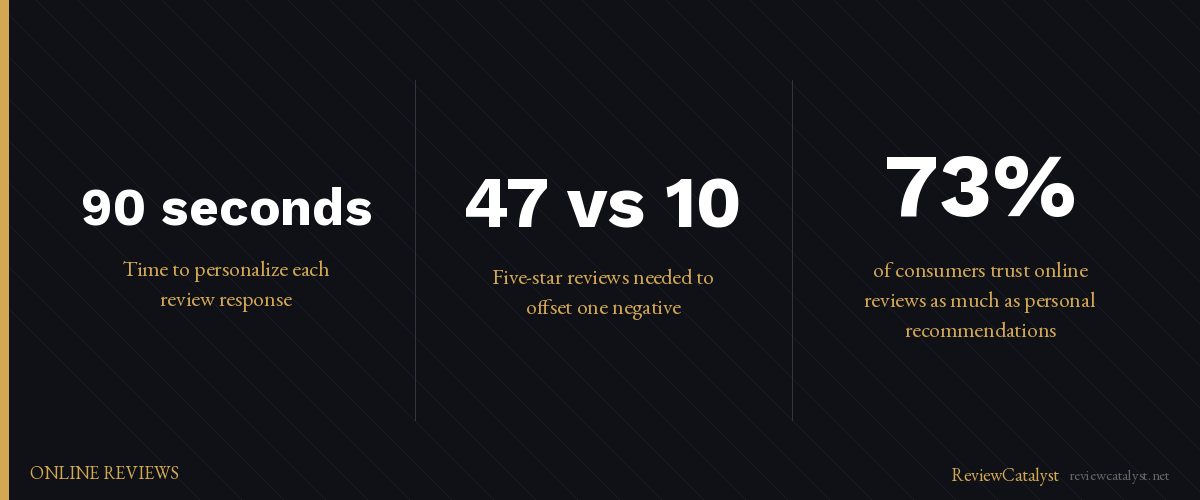
Don’t respond the same way to every review. Copying and pasting a generic template response is transparent and insulting. Spend 90 seconds personalizing each one.
Don’t ignore it. Silence looks worse than a thoughtful response. Every day a negative review sits unanswered, it gains credibility.
How to Manage Multiple Negative Reviews
Here’s the real challenge: if you’re running a busy service business, you might get 10, 20, or 50 reviews a month across Google, Facebook, and other platforms. Responding thoughtfully to each one takes time—time most owners don’t have. So you either burn out trying to keep up, or you start copying and pasting the same generic response. And customers notice.
The solution isn’t to respond less. It’s to respond smarter. ReviewCatalyst drafts personalized responses for you in seconds, so you can stay present without the time sink. You’re still writing—you’re just not starting from scratch every time.
The goal is to respond to every review, not just the negative ones. Consistent responses signal to potential customers that you’re engaged and present.
The Long-Term Play: Turning Reviews Around
Negative reviews stick around. But they fade into the background when they’re surrounded by dozens of positive ones and a consistent pattern of professional responses.
Here’s the math: A business with 47 five-star reviews and one one-star review looks better than a business with 10 five-star reviews and one one-star review. Volume matters.
A consistent pattern of professional, empathetic responses matters even more. When potential customers see that you respond thoughtfully to every review—positive and negative—they trust you more.
That’s the real play: build a system that gets you more positive reviews and makes sure you respond to every single one. The negative reviews don’t go away, but they become noise in a sea of good experiences and great customer service.
Negative reviews stick around. But they fade into the background when they’re surrounded by dozens of positive ones and a consistent pattern of professional responses. That’s the game: build a system that gets you more reviews and makes sure you answer every single one. ReviewCatalyst handles the replies so you don’t have to—drafting thoughtful, personalized responses in seconds. Try it free for 14 days at reviewcatalyst.net — no credit card required.
Ready to get more reviews on autopilot?
ReviewCatalyst sends review requests via SMS automatically — no manual follow-up, no chasing customers.
Start Free Trial