How Hotels and Short-Term Rentals Can Manage Their Online Reputation
A single negative review on Google can cost a hotel significantly—not just reputation points, but real bookings. Most hotels don’t see it for days.
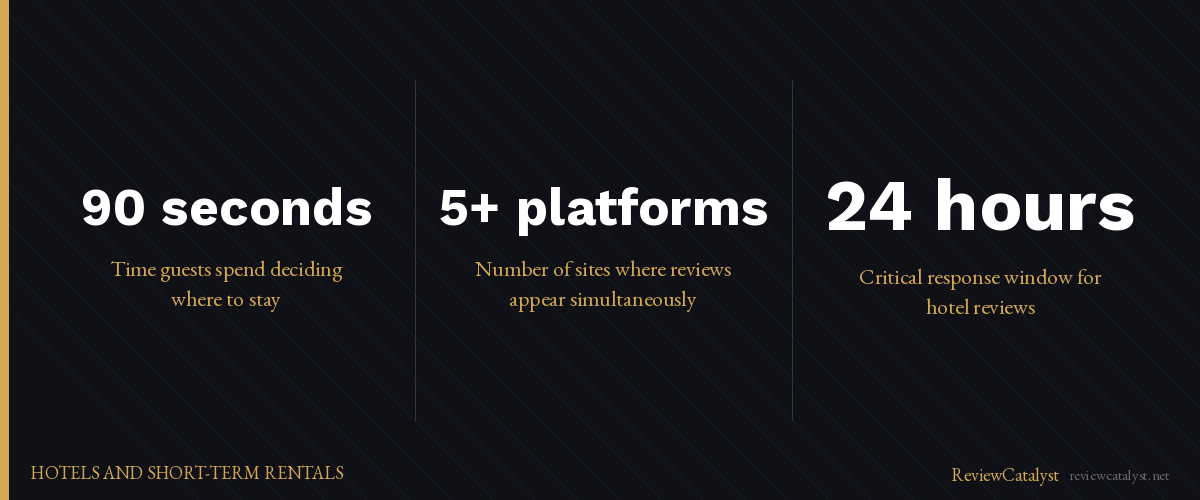
That’s the reality of online reputation management in hospitality. Unlike restaurants or retail stores where a bad review is frustrating, a negative hotel review directly impacts bookings. Guests spend 90 seconds on Google Maps before they decide where to stay. If your most recent review is a complaint about dirty rooms or noise, they move to your competitor.
The issue isn’t that you don’t care about your reputation. The issue is that your reviews are scattered across 5+ platforms, responses are slow, and you’re answering the same complaint in three different places. Meanwhile, your competitors have a system.
Here’s how to fix it.
Why Hotel Reputation Management Is Different From Other Businesses
Your guests decide to book in seconds. A potential guest lands on Google Maps, sees your hotel, reads the last three reviews, and makes a decision. If a negative review sits at the top for 72 hours, you’ve lost that booking.
Reviews appear across 5+ platforms simultaneously. A guest leaves a review on Google. It hits Booking.com, Expedia, and your own website at the same time. You’re now managing the same feedback in five different dashboards. Most hotel managers respond only to Google.
A single negative review costs you real revenue. It’s not abstract reputation damage—it’s a lost night, a cancelled reservation, a booking that went to your competitor down the street.
Response time matters more in hospitality than any other industry. A plumber has days to respond to a review. A hotel has hours. Every hour a negative review sits unanswered is a booking opportunity lost.
The Problem With Managing Reviews Manually
You’re spending 45 minutes a day logging into different platforms, copying and pasting similar responses, and hoping you don’t miss a critical review. Here’s what that looks like:
- Monday: A guest leaves a 3-star review on Google complaining about the Wi-Fi
- Tuesday morning: You see it on Google and respond
- Tuesday afternoon: You notice the same guest left a review on Booking.com, but your response wording doesn’t match
- Wednesday: A different guest leaves a 2-star review on Expedia. You don’t see it until Friday because you only check Expedia once a week
- Friday: You’ve lost two potential bookings to competitors whose reviews look fresher
You’re not actually managing your reputation—you’re just reacting to it.
The worst part? You can’t scale this. If you own three properties or manage a chain, you’re doing this across 15+ review streams. The system breaks, reviews pile up, and your rating tanks.
What a Centralized Reputation System Does for Hotels
A centralized platform pulls every review—Google, Booking.com, Expedia, Airbnb—into one dashboard. You get instant alerts when a new review posts, so you can respond while the guest is still thinking about their stay.
AI-assisted responses save time and keep your voice consistent. Instead of typing the same apology for the fifth time, you use a template that matches your brand. You respond in 60 seconds instead of 10 minutes.
One place to see all reviews, all platforms. Everything lands in your inbox the moment it’s posted. You spot patterns. Three guests complained about breakfast. Two mentioned the shower. One praised the staff. That tells you what to fix.
Review widgets for your website. Live review feeds build trust with visitors before they book. Potential guests see real feedback from real past guests—and that converts.
The Right Way to Respond to Hotel Reviews
Responding quickly is necessary. But responding well is what protects your rating.
Respond within 24 hours. This is the booking window. A guest reads your response and decides whether you’ve addressed their concern. If it takes you a week to respond, they’re already staying somewhere else.
Address specific complaints directly. Don’t write: “We appreciate your feedback and we’ll do better.” Write: “We’re sorry the Wi-Fi was slow during your stay. We’ve upgraded our router and we’d love to have you back to experience the difference.”
Use negative reviews as operational intelligence. A 2-star review isn’t just damage control—it’s a roadmap. If five guests in a month complain about checkout times, that’s a staffing problem. Fix it, and your next guest leaves a 5-star review.
Invite guests back in positive review responses. When a guest leaves a 5-star review, thank them and extend an invitation: “Thank you! We’d love to welcome you back next time you’re in town.” Many guests don’t realize they can rebook—your response is the nudge they need.
How to Get More Positive Reviews From Guests
You can’t manage your reputation on defense alone. You also need more positive reviews drowning out the negative ones.
The QR code at checkout. A scannable code on the check-out receipt that takes guests directly to a review form. This works because it’s in the moment—while they’re still in your lobby, while the good experience is fresh.
Pre-arrival email with a review reminder. Send a welcome email 24 hours before check-in. Include a note asking them to share their experience after they leave. You’re planting the seed early.
Post-stay text message. A text message 2-3 days after checkout asking for feedback. SMS gets opened far faster than email.
Integrate review requests into your existing guest communications. Don’t add another tool to your stack. Add the request to your checkout email, your thank-you SMS, your loyalty program. Weave it into what you’re already doing.
Building a Reputation System That Scales
If you manage multiple properties, you need a system that works without multiplying your workload.
Automation for high-volume review requests. Instead of manually texting or emailing guests, set up automated campaigns that trigger after checkout. Every guest gets asked—no one falls through the cracks.
Consistency across properties. One dashboard for all three locations. One set of response templates. One reputation strategy. Your Fort Lauderdale property and your Miami property operate with the same standards.
Widgets that display reviews on your booking page. Live review feeds on your website build trust. Visitors see real guest feedback before they book. This converts browsers into bookers.
Tracking reputation trends over time. You’re not just responding to today’s review. You’re watching your rating trend week to week, month to month. You know when something is working and when it’s not.
Every hour a negative review sits unanswered is an hour a guest is booking your competitor instead. ReviewCatalyst puts all your reviews in one place and helps you respond professionally in minutes—not days. See how it works free for 14 days at reviewcatalyst.net. No credit card required.
Ready to get more reviews on autopilot?
ReviewCatalyst sends review requests via SMS automatically — no manual follow-up, no chasing customers.
Start Free Trial